
End-of-life renewables now become high-value feedstocks. Discover the importance of global buyers of recycled materials.
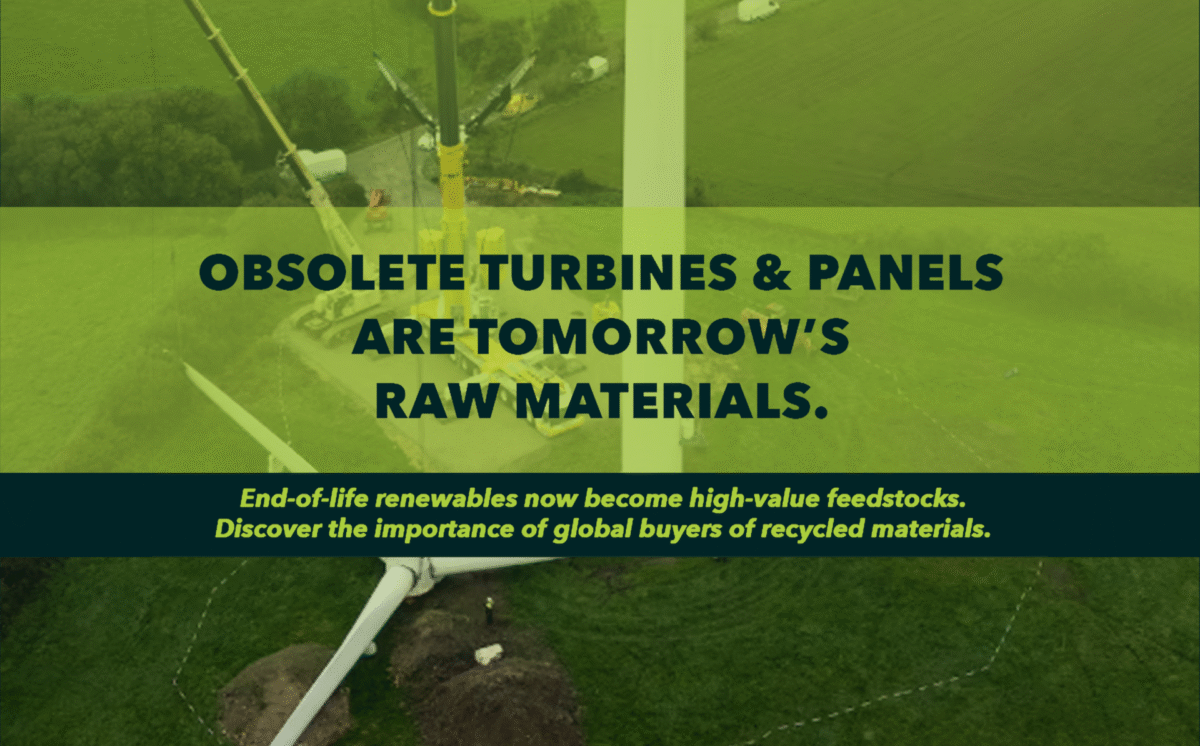
End-of-life renewables now become high-value feedstocks.
A recent review from Spain and Europe highlights the looming wave of wind-turbine blades and solar panels reaching obsolescence — up to 400,000 tonnes of solar panels alone by 2030.
Here’s how this matters for global buyers of recycled materials:
Wind turbines can already recycle 85-90% of their mass, yet blades made of composite materials remain a major challenge — and an opportunity.
A plant in Navarra (Spain) now processes 10,000 t/year of blades and uses recovered materials in cement and polymer components.
Solar panel modules nearing end-of-life contain high-value materials such as aluminium, glass, silicon, and lesser-used elements like indium and tellurium — unlocking new resource streams for sustainable manufacturing.
What this means for materials suppliers:
With renewable energy installations aging globally, a new supply chain of large-volume recyclable materials is emerging.
If you can supply clean, traceable, pre-processed streams from these end-of-life assets, you’re not just a vendor — you become a strategic partner for manufacturers looking to meet circular-economy targets.
-Verify that materials come from decommissioned renewables installations or certified collection channels.
-Ensure removal of contaminants and components that complicate recycling (e.g., composite resins from blades).
-Position your offering as “renewables-feedstock ready” — highlighting that the waste stream originates from wind or solar infrastructure.
-Share documentation of source, chain-of-custody and potential reuse applications (cement, building materials, polymers).
-Emphasize how this material supports decarbonisation goals and circular-economy commitments in global supply chains.
Let’s turn what was once waste into a value-chain-transforming opportunity.