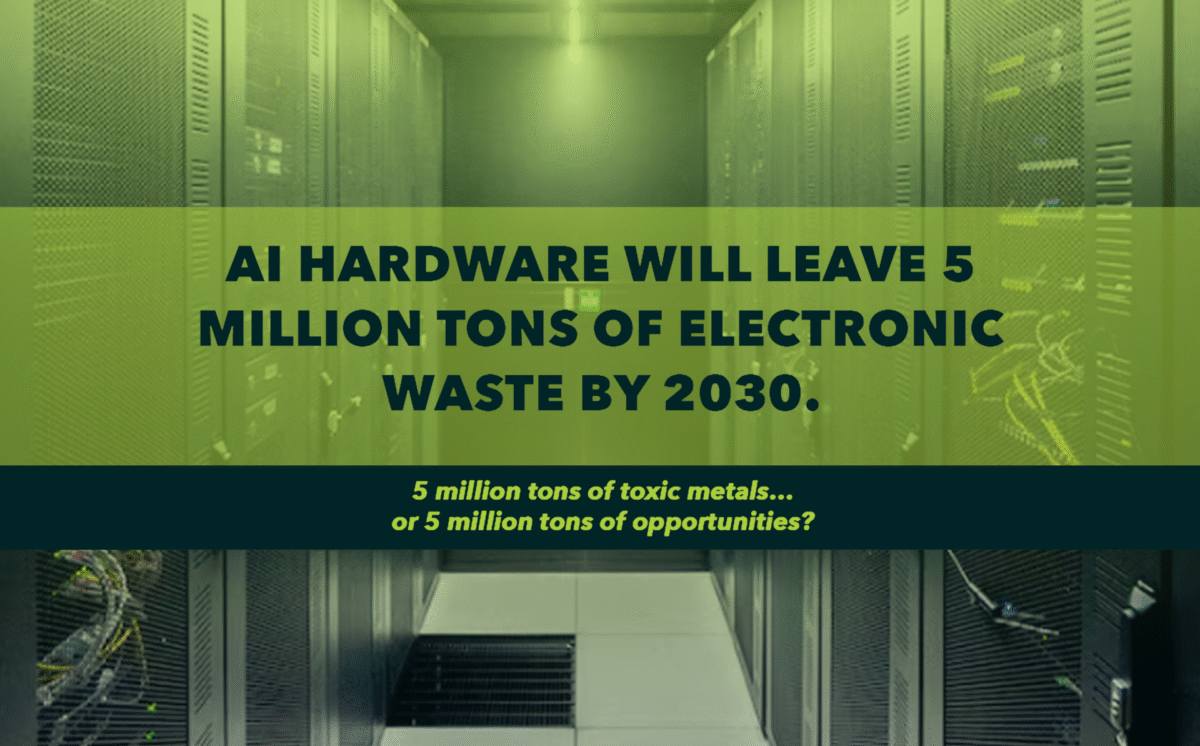

5 million tons of toxic metals… or 5 million tons of opportunities?
The generative AI race between Google, Microsoft, Meta, and others is creating an e-waste crisis—and a massive opportunity for the secondary materials market.
A new study published in Nature Computational Science reveals a projection: electronic waste from AI data centers could multiply by 1,000x by 2030, reaching 1.2 to 5 million tonnes annually.
AI systems like ChatGPT, Gemini, Copilot, and Claude require constant hardware upgrades in data centers running 24/7. These servers have limited lifecycles (3-5 years) due to:
– Intensive computational demands of training LLMs
– Heat degradation from continuous operation
– Rapid technological obsolescence
– Performance requirements for generative AI workloads
WHAT THIS MEANS FOR RECYCLED MATERIAL BUYERS:
This emerging waste stream contains recoverable materials:
– metals: Gold, silver, palladium (circuit boards, connectors)
– Base metals: Copper (wiring, heat sinks), aluminum (chassis, cooling systems)
– Hazardous but valuable: Lead, chromium, cadmium (requiring specialized processing)
For procurement managers sourcing recycled feedstock, this represents:
– Volume surge: Current e-waste infrastructure may not scale fast enough—early partnerships with specialized processors will be strategic.
– Quality consideration: Data center hardware is often well-documented, making material composition more predictable than consumer electronics.
– Regulatory pressure: Tech giants face increasing circular economy mandates (EU Digital Product Passport, Extended Producer Responsibility)—this could formalize reverse logistics channels.
– Price dynamics: Sudden supply increase of specific metals (copper, gold) from server decommissioning could affect commodity pricing—monitor data center upgrade cycles.
THE CIRCULAR ECONOMY ANGLE:
Lead author Peng Wang (Chinese Academy of Sciences) emphasizes the race is between GenAI expansion rate vs. circular economy adoption. His concern: “Without immediate shock measures, the waste generation will outpace recycling infrastructure.”
The study projects exponential growth between 2025-2030. Early movers in securing feedstock agreements from this emerging stream will have competitive advantage as traditional e-waste sources (smartphones, laptops) face saturation.
This isn’t just an environmental story. It’s a supply chain disruption signal for anyone in the recycled materials market.